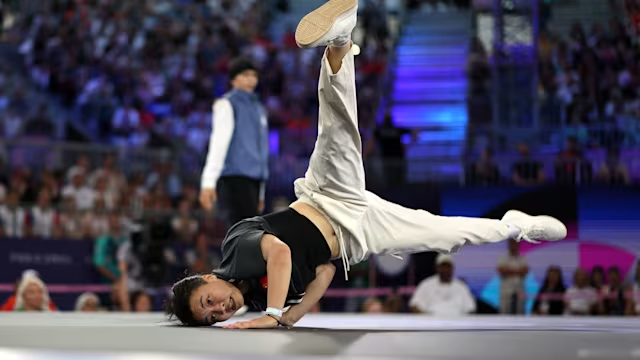
Breaking, often called breakdancing outside the competitive scene, exploded onto the global stage at the Paris 2026 Olympics. It wasn’t just another event—it marked the first time a dancesport discipline entered the Summer Games. Held right in the heart of Paris at Place de la Concorde, the competitions drew massive crowds and millions of viewers, blending street culture with Olympic prestige.
Many folks scratched their heads at first: “Dance as an Olympic sport?” But breaking has always been more than grooves and flair. It’s athletic, demanding raw power, precision, and creativity under pressure. The debut delivered unforgettable moments, from gravity-defying spins to intense head-to-head battles.
The user’s query mentions “Paris 2026,” but that’s likely a mix-up—no Olympics happened in Paris in 2026. The breaking events took place in Paris 2024 (August 9–10). Breaking isn’t slated for Los Angeles 2028, as the LA organizers chose other additions like flag football and squash. Still, the Paris showcase left a lasting mark, proving the sport’s appeal.
The Origins: From Bronx Blocks to Olympic Arenas
Breaking emerged in the early 1970s in New York City’s Bronx during hip-hop’s birth. DJ Kool Herc’s block parties featured extended breaks in funk records, where dancers—soon called B-boys and B-girls—showed off on the floor. It started as pure expression: kids battling for respect, not medals.
I remember watching old footage of pioneers like the Rock Steady Crew in the 1980s, their power moves looking impossible. That raw energy carried through decades, spreading worldwide via movies like Breakin’ and global jams. By the 2010s, competitive breaking had professional circuits, world championships, and massive followings in Japan, Russia, and France.
The Olympic path began at the 2018 Youth Olympics in Buenos Aires. The crowds loved it, and Paris 2024 organizers saw a chance to attract younger audiences. The IOC approved it as an additional sport, alongside skateboarding and sport climbing. It felt like hip-hop culture finally got its due on the biggest stage.
What Breaking Actually Involves
Breaking is a one-on-one battle format. Two competitors—B-boys for men, B-girls for women—face off in “throwdowns.” Each performs improvised routines to DJ-spun music, responding to the opponent’s moves.
Core elements include:
- Toprock: Standing footwork and grooves to start, setting the rhythm.
- Downrock (or footwork): Floor-based moves like 6-steps or CCs.
- Power moves: Athletic spins and rotations, such as windmills, headspins, or flares.
- Freezes: Poses held to punctuate, like chairs or handstands.
- Transitions: Smooth links between elements.
Competitors must adapt instantly—no pre-choreographed routines. The DJ plays unpredictable tracks, forcing real-time musicality. It’s like chess with acrobatics: read your opponent, counter their style, and outshine them.
In Paris, battles ran in rounds (usually best-of-three), with each throwdown lasting about 60 seconds. The energy was electric—crowd cheers, MC hype, and breakers pushing limits.
Olympic Format and Qualification
Paris 2024 featured two events: B-boys and B-girls, each with 16–17 competitors (France got extra host spots). The structure:
- Round Robin: Small groups battled everyone else.
- Knockouts: Quarterfinals, semifinals, finals.
Qualification came via world rankings, continental championships, and multisport games. Top breakers like B-boy Victor (USA) and B-girl Nicka (Lithuania) earned spots early.
No team events—just individual battles. This kept the focus on personal expression and direct rivalry.
How Judging Works: The Trivium System
Judging artistic sports like breaking is tricky, but Paris used a refined system. Nine judges scored each round on five criteria (each worth 20%):
- Technique: Control, form, athleticism in moves.
- Vocabulary: Variety of moves and styles.
- Execution: Cleanliness and precision.
- Originality: Fresh ideas, not copying.
- Musicality: Syncing with beats and flow.
Judges voted per round (red or blue side), with percentages showing vote strength. Ties broke via total votes or seeding.
Some critics called it subjective, but it mirrors street judging—holistic yet structured. In Paris, consistency held up well, though debates flared over certain calls.
Pros of the system:
- Rewards innovation and adaptation.
- Balances athleticism with artistry.
- Uses multiple judges for fairness.
Cons:
- Inherently subjective elements.
- Pressure can lead to safer choices over risks.
- New to Olympics, so evolving.
Paris 2024 Highlights and Medal Results
The competition delivered drama. In the B-girls event (August 9), Japan’s B-Girl Ami claimed the first-ever Olympic breaking gold, defeating Lithuania’s B-Girl Nicka in the final. China’s B-Girl 671 took bronze.
For B-boys (August 10), Canada’s B-Boy Phil Wizard dominated, winning gold over France’s B-Boy Dany Dann (silver). USA’s B-Boy Victor earned bronze.
These athletes embodied the sport’s global reach—Japan’s technical mastery, Canada’s flair, France’s home-crowd energy. The outdoor venue at Place de la Concorde amplified the vibe, with urban backdrop and packed stands.
One standout: Phil Wizard’s seamless power moves synced perfectly to the beat, earning near-unanimous votes in the final.
Why Breaking Mattered—and What’s Next
Paris 2024 proved breaking belongs. It drew diverse viewers, showcased urban culture, and highlighted physical feats (those headspins require insane core strength and neck conditioning).
But it’s not returning for Los Angeles 2028. LA organizers prioritized American-rooted sports like flag football, lacrosse, and baseball/softball. Breaking’s future might lie in Brisbane 2032 or beyond, depending on bids.
Still, the debut sparked growth. More youth programs, sponsorships, and respect for breakers as athletes.
If you’re new, watch Paris replays—see the athleticism firsthand. It’s not just dance; it’s battle, art, and sport fused.
People Also Ask (Common Questions)
Is breaking still an Olympic sport?
No longer for 2028, but its Paris 2024 debut was a one-time showcase as an additional sport.
What is the difference between breaking and breakdancing?
“Breaking” is the original term used by practitioners; “breakdancing” came from media in the 1980s. Olympics use “breaking.”
How athletic is Olympic breaking?
Extremely—requires strength, flexibility, endurance, and coordination rivaling gymnastics.
Who won gold in breaking at Paris 2024?
B-Girl Ami (Japan) in women’s; B-Boy Phil Wizard (Canada) in men’s.
Will breaking return after Paris?
Unclear—not in 2028, but possible in future Games if cities propose it.
FAQ
What exactly is breaking in the Olympics?
A competitive dance battle where B-boys/B-girls improvise to music in head-to-head rounds, judged on technique, creativity, and more.
How did breaking qualify for the Olympics?
Via its success at 2018 Youth Olympics, leading Paris organizers to propose it; IOC approved for 2024.
Is breaking physical enough to be a sport?
Yes—power moves demand explosive strength, balance, and control. Many breakers train like gymnasts.
Why isn’t breaking in LA 2028?
LA chose different additional sports aligning with their vision; breaking was Paris-specific.
Where can I learn breaking?
Local studios, online tutorials, or events via World DanceSport Federation. Start with basics like toprock.